
Unconfined Compression Strength Testing

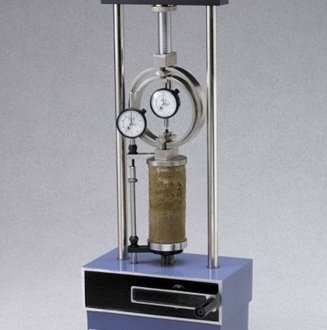
Unconfined Compression Strength (UCS) Testing:
The Unconfined Compression Strength Test is a laboratory test used to determine the compressive strength of cohesive soils (usually clays) without any lateral confinement. It is one of the simplest and quickest methods to evaluate the shear strength of saturated cohesive soils.
Purpose of UCS Testing:
The primary purpose of UCS testing is to determine the unconfined compressive strength (qu) of a soil sample, which helps in evaluating the soil's load-bearing capacity and shear strength. This value is essential for geotechnical design and construction, especially for foundations and embankments.
Test Procedure for UCS Testing:
- Sample Preparation: A cylindrical soil specimen (standard dimensions are 38 mm diameter and 76 mm height) is prepared, either from undisturbed samples or by remolding saturated cohesive soil.
- Placement in Loading Device: The specimen is placed vertically between the platens of the unconfined compression testing machine.
- Loading: The specimen is compressed axially at a constant rate of strain (usually 1% to 2% per minute) until failure occurs.
- Recording Data: The axial load and corresponding deformation are recorded throughout the test until the sample fails or a peak load is observed.
Calculation of Results:
The unconfined compressive strength (qu) is calculated using the formula:
qu = P / A
Where:
- P = Axial load at failure (N)
- A = Cross-sectional area of the specimen (mm²), corrected for deformation if needed
The shear strength (s) of the soil is then:
s = qu / 2
UCS Test Results:
- Unconfined Compressive Strength (qu): Indicates the maximum axial compressive stress the soil can withstand without lateral support.
- Shear Strength (s): Half of the unconfined compressive strength, assuming failure occurs along a plane of maximum shear stress.
Importance of UCS Testing:
This test is important for:
- Evaluating the load-bearing capacity of cohesive soils.
- Determining undrained shear strength parameters used in foundation design.
- Assessing the stability of slopes and embankments in cohesive soils.
- Quick field-based assessments of soil strength where triaxial testing is not feasible.
Applications of UCS Testing:
- Design and analysis of shallow and deep foundations.
- Construction of earth dams, retaining structures, and slopes.
- Evaluation of ground improvement and soil stabilization measures.
Test Method:
IS: 2720 (Part 10) – 1991 provides the standard procedure for conducting Unconfined Compression Strength Testing in India.
Want to speak to our Customer Care Executive?
Just Submit Your Contact Details and We’ll be get in Touch With You Shortly.