
Shrinkage limit Testing

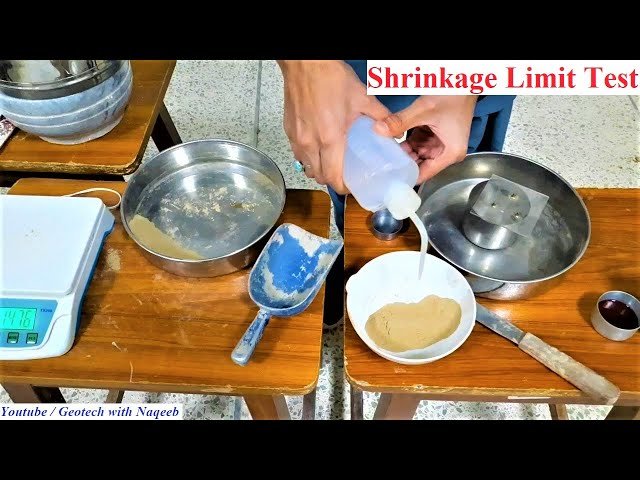
Shrinkage Limit Testing:
The Shrinkage Limit Test is a laboratory test used to determine the shrinkage limit (SL) of a soil, which is the moisture content at which the volume of the soil no longer decreases as the moisture content is reduced. This test is essential for understanding the volume change characteristics of fine-grained soils, particularly for shrinkage and swelling behavior in civil engineering projects.
Purpose of Shrinkage Limit Testing:
The primary purpose of the Shrinkage Limit Test is to determine the moisture content at which a soil, when dried, reaches the point where it will not further shrink. This moisture content is used to assess the soil's behavior during drying and its suitability for construction, particularly in areas where soil volume change may affect the stability of structures or pavements.
Test Procedure for Shrinkage Limit Testing:
- Soil Sample Preparation: A representative soil sample is taken, typically after sieving to remove particles larger than 4.75 mm. The sample is thoroughly mixed to ensure a uniform consistency.
- Moisture Content Determination: The initial moisture content of the soil is measured, and a portion of the sample is placed in a shrinkage dish (a small container). The sample is then evenly spread to ensure uniform thickness.
- Drying the Soil: The soil in the shrinkage dish is slowly dried in an oven at a temperature of 105°C until it reaches a constant weight.
- Measurement of Volume: The volume of the soil in the shrinkage dish is measured after drying. This is typically done using a mercury displacement method or other suitable volume measurement techniques.
- Final Measurement: The shrinkage limit is determined by comparing the volume of the soil at its shrinkage limit (after drying) to its original volume when fully saturated.
Calculation of Results:
The shrinkage limit (SL) is calculated using the formula:
Shrinkage Limit (SL) = (Weight of the soil at shrinkage limit / Volume of the soil at shrinkage limit) * 100
The result gives the moisture content at which the soil's volume does not reduce further as it is dried. The shrinkage limit is typically expressed as a percentage.
Shrinkage Limit Test Results:
The result of the Shrinkage Limit Test provides the following important value:
- Shrinkage Limit (SL): The moisture content at which the soil no longer shrinks when dried. It is expressed as a percentage of the dry weight of the soil.
Importance of Shrinkage Limit Testing:
Shrinkage Limit Testing is crucial for the following reasons:
- It helps determine the shrinkage potential of fine-grained soils, which is important for evaluating soil behavior in dry conditions.
- Used to assess the risk of soil shrinkage or cracking, which can affect the stability and performance of structures and pavements.
- Helps in soil classification and provides information on soil volume changes, especially in areas subject to varying moisture conditions.
Applications of Shrinkage Limit Testing:
Shrinkage Limit Testing is used in various civil engineering applications, including:
- Designing foundations and pavements in areas with expansive soils.
- Evaluating the suitability of soil for embankments and earthworks.
- Assessing the risk of soil cracking and volume change under varying moisture conditions.
- Soil classification and quality control for construction projects.
Test Method:
IS: 2720 (Part 6) – 1972 provides the standard procedure for performing the shrinkage limit test in India.
Want to speak to our Customer Care Executive?
Just Submit Your Contact Details and We’ll be get in Touch With You Shortly.